Colorant Sets & Sample Preparation
Learn to create and edit a colorant set, select reference white and black, and prepare real laboratory samples.
Colorant Sets & Samples
Create and edit a set, choose reference colors and prepare real laboratory samples.
What is a colorant set?
It is a database of the real white, black and other colorants you use. You make paint samples, record their actual mixtures, measure their colors and enter the results in MEC. MEC uses this information to predict and correct recipes.
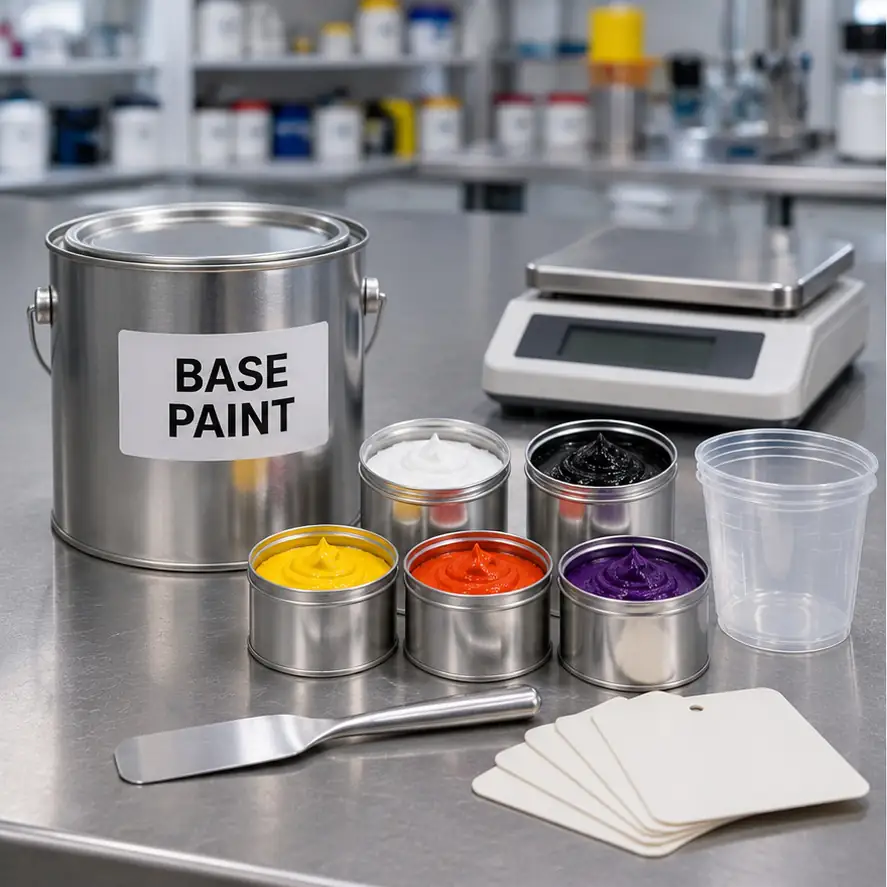
How do I create a new colorant set in MEC?
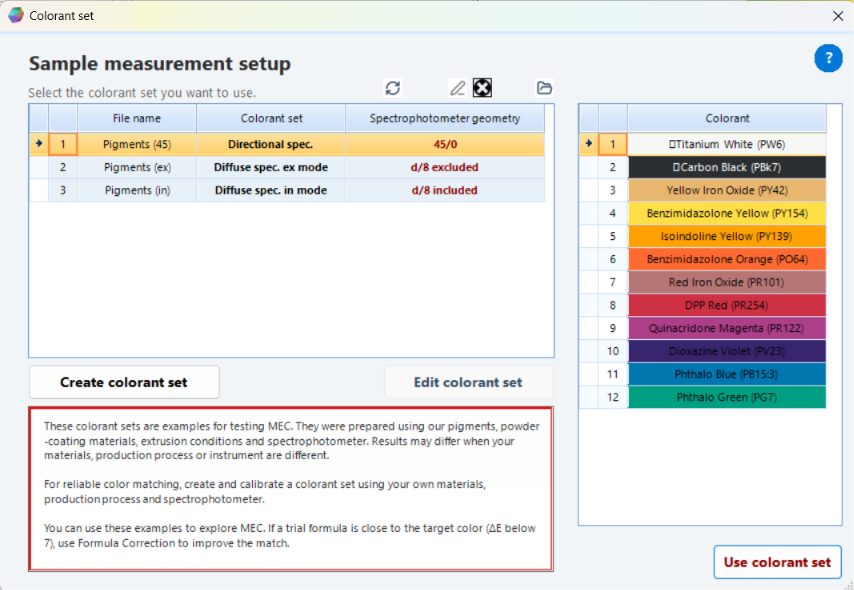
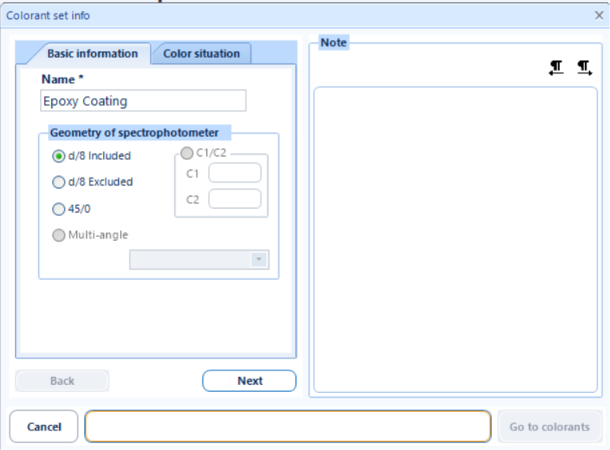
On the Colorant Set selection screen shown below, click Add. Enter a name and the correct measuring geometry and lighting settings. Define reference white and black, add other colorants and their measured mixtures, then calibrate the set. Follow the separate laboratory guide to prepare samples.
How do I edit an existing colorant set?
On the same Colorant Set selection screen, select your existing set and click Edit next to Add. Review or change its colorants and measurements, then recalibrate and validate the revised set.
What do reference white and reference black mean?
They are the two main reference materials used in characterizing your other colorants. Ideally, reference white is the whitest suitable white commonly used in your factory and reference black is the darkest available production black.
I have several whites and blacks. Which should be the references?
Choose the brightest suitable production white with good hiding and the deepest practical production black. You can still add the other whites and blacks as ordinary additional colorants.
How do I add extra white or black colorants?
Add each with New Colorant just as for any colored paste. Mix an additional black with reference white to make several shades. Mix an additional white with reference black. Measure the finished mixtures and enter the actual concentrations.
What if my base paint is already white?
If your base already contains white pigment, you may choose the white base itself as reference white. Apply and measure that base by itself with full hiding; do not add a separate white paste for the reference. Define any additional white paste as a separate colorant.
If my white base is reference white, what does mixing with white mean?
It means mixing the other colorant with the white base itself. Do not add a separate white pigment paste unless it is part of your actual production formula.
How do I prepare the reference black mixtures?
Mix reference black with reference white at several concentrations, covering pale gray through very dark black. MEC's tour needs at least two measured mixtures and recommends at least five for good characterization.
How do I make samples for dark purple or another dark colorant?
Prepare several mixtures with reference white, from pale to dark. Mixing that dark colorant with reference black is usually unnecessary if the required shade range is already covered.
How do I make samples for yellow, red or orange?
Prepare mixtures with reference white. For bright colorants that stay relatively light, also make suitable mixtures with reference black to include darker shades in the database.
How many physical samples should I make?
Make enough to describe the useful range from light to dark. The reference black needs at least two mixtures; five or more are recommended. For other colorants, several well-spaced samples are better than many nearly identical samples.
Should samples have equal changes in pigment percentage?
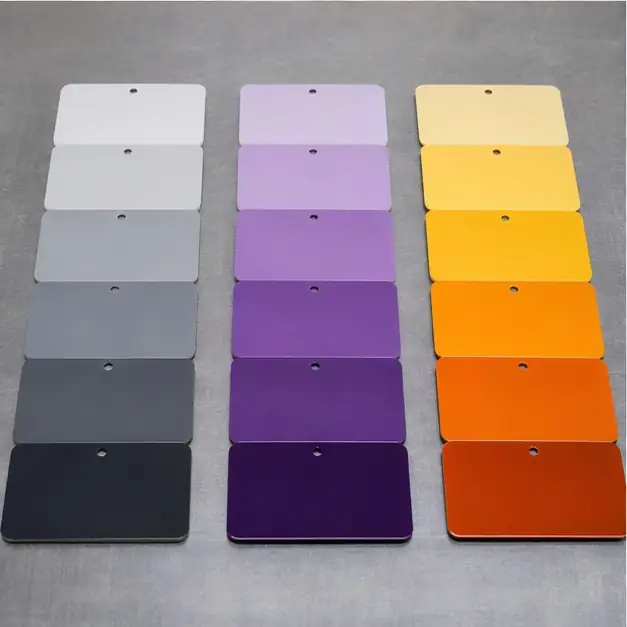
Not necessarily. Aim for reasonably even changes in the actual color from light to dark. Strong pigments can change color quickly at low concentrations, so equal pigment percentages may not give equal color steps.
Can MEC suggest the best intermediate mixtures?
Yes. Prepare and measure at least two mixtures, ideally one light and one dark. The Suggest Best Mixtures step in the Colorant Set Tour lets you set concentration limits and proposes useful additional mixtures to prepare and measure.
Must I use the same percentages as in actual production?
Yes. This is essential. If you use 20% of a paste in the actual product, its characterization samples must follow the real formulation system. If black is normally used at 3% instead, preserve that different amount. Do not invent laboratory-only ratios.
What does a 20% colorant formula mean for 100 g of paint?
When the specified percentage is by total mass, use 20 g of colorant paste and 80 g of the corresponding base or other specified ingredients. If your real recipe has more components, follow that real formula and record every amount.
Should I enter pure pigment quantity or paste quantity?
Enter the quantity of the material you actually weigh. If you dispense pigment paste, use paste weights; if you dispense pure pigment, use pigment weights. Keep paste composition and pigment strength consistent between batches.
Do I need a different process for colorant-set samples?
No. Use the same ingredients, base, mixing order, dispersion, application method and drying or curing conditions as your usual product or customer samples. You can make a smaller batch in the laboratory.
Can I create the set in a laboratory and use it in production?
Yes, if the laboratory and factory use sufficiently similar materials and conditions. Validate the match with a real production sample. MEC correction may reduce some differences, but a substantially different process may require updated characterization.
Do samples need to be fully opaque or have full hiding?
Full hiding is strongly recommended so the substrate does not change the measurement. If it is not possible, MEC may reduce some related color error during later formulation correction, but it cannot guarantee a fix. Aim for fully hiding samples first.
Can I apply a thicker coat than in normal production?
Yes, if you need extra thickness to achieve full hiding on a calibration panel. Keep the surface smooth and representative, without orange peel, unusual gloss or runs. Then check the final recipe at the real production thickness.
Where should I measure a panel that has uneven thickness?
If you have a coating-thickness gauge, identify a sufficiently thick, uniform, well-hiding area. Then measure the color there with your spectrophotometer or colorimeter; a thickness gauge does not measure color.
Does orange peel, roughness or gloss change matter?
Yes. Surface texture and gloss can change measured color. Avoid orange peel, streaks and other defects when making the colorant-set samples, even if you need to increase coating thickness.
Can I use one colorant set for every paint base or material?
Not automatically. Different binders, bases, pigment systems, substrates and curing conditions can change the result. Build or validate separate sets for substantially different systems.
What if a calibration sample shows a large ΔE?
Recheck its actual formulation, identification, opacity, surface finish, measurement conditions and entered numbers. Re-measure or remake it. If it is still a clear outlier, consider excluding it from calibration.
Can I reuse a set after changing supplier or paste batch?
Check a control sample. Significant changes in pigment strength or paste composition can make the old database inaccurate. Update the affected measurements or build a separate set if needed.
Can I store different colorant sets?
Yes. Create separate sets for different bases, factories, products or measurement conditions. Give them clear names so you use the correct one for each job.
Can free MEC Core create my own colorant set?
The public MEC website currently describes Core as allowing up to five custom colorants per set; included default sets are separate from this limit. Check the MEC Plans page for current edition details.
All answers are provided as readable text and structured data. Features and instructions may vary by MEC edition and measuring instrument.