Color Measurement & Instruments
Understand spectrophotometers, colorimeters, CIE L*a*b*, ΔE and practical color measurement.
Color Measurement & Instruments
Learn how to measure a color and understand the instruments and numbers.
What does measuring color actually mean?
It means placing an appropriate measuring instrument on a prepared target or paint sample and recording repeatable numbers describing its color, commonly L*, a* and b*. It is not the same as taking a phone photo.
What is a spectrophotometer?
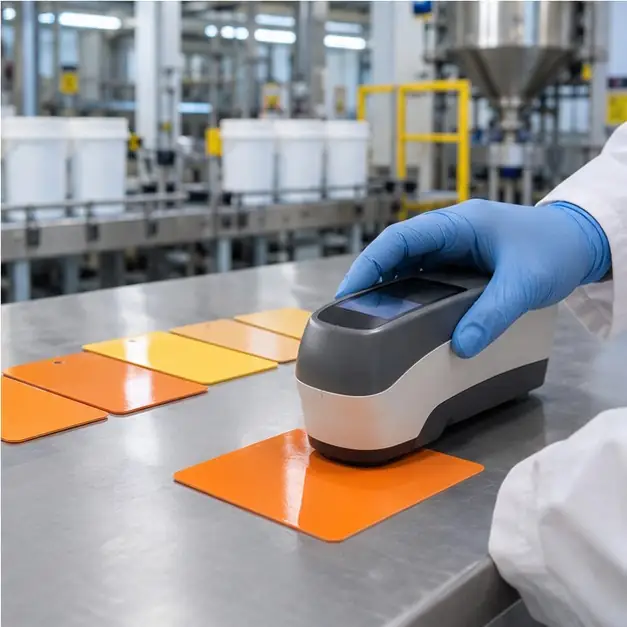
It is an instrument that measures how much light a surface reflects at different wavelengths. It can calculate L*a*b* values and often reflectance spectra under defined measurement conditions.
What is a colorimeter?
A colorimeter is a device that uses filtered sensors to estimate color values such as L*a*b*. It can be suitable for basic MEC workflows when its readings and settings are reliable and compatible.
What is the difference between a spectrophotometer and colorimeter?
A spectrophotometer measures detailed spectral reflectance, while a colorimeter normally uses several filtered sensors. Both may report L*a*b*, but a colorimeter may not support calculations for many lighting conditions.
How do I measure a paint sample step by step?
- Apply paint on a clean representative panel.
- Dry or cure it fully.
- Find a smooth, clean, well-hiding area.
- Calibrate the instrument as specified by its manufacturer.
- Select matching illuminant, observer and geometry.
- Place the measuring head flat on the sample.
- Take repeated readings and record L*, a*, b*, sample ID and settings.
What are L*, a* and b*?
L* is lightness: low means dark and high means light. Negative a* is greenish and positive a* reddish. Negative b* is bluish and positive b* yellowish. These values depend on the chosen illuminant and observer.
What is ΔE (Delta E)?
It is a numerical measure of the color difference between two samples. Lower values usually mean a closer match, but the exact acceptability depends on the ΔE equation and your product's tolerance.
What are D65, F11 and A light sources?
D65 represents average daylight, F11 a particular fluorescent light, and A a warm incandescent-like light. A pair of colors may match under one and differ under another.
What do 2° and 10° observer mean?
They are standardized models of human color vision used to calculate color values. Use the observer required by your measuring procedure and keep target and sample settings consistent.
What do d/8 and 45°/0° geometry mean?
Geometry describes how the instrument illuminates and sees the surface. Different geometries may give different results, especially on glossy or textured paint. Target and samples should use compatible geometry.
What are SCI and SCE?
On suitable sphere instruments, SCI includes mirror-like reflection and SCE excludes it. Do not accidentally compare an SCI target reading with an SCE sample reading.
Do I need to calibrate my instrument?
Follow the manufacturer's recommended calibration using approved calibration tiles or standards. Ordinary paper is not a substitute for the calibrated reference tile.
Should I measure a sample more than once?
Yes, where practical. Measure several clean, uniform positions and check they agree. If values vary widely, investigate uneven paint, texture, hiding or instrument handling before averaging.
Can I measure wet paint instead of a dry panel?
For a final dry or cured coating, measure it after drying or curing. Wet paint may change color significantly. Only use wet readings if you have a validated procedure for that system.
Why does the surface under the paint matter?
If the coating is not fully hiding, the color of the substrate can influence its measured color. Use a representative substrate and sufficient thickness for reliable characterization.
Is a thickness gauge the same thing as a spectrophotometer?
No. A thickness gauge measures how thick the coating is; the spectrophotometer or colorimeter measures color. Use the two instruments for different purposes.
Can I measure color with my mobile phone camera?
A normal phone camera is not a reliable substitute for a calibrated color instrument. Exposure, lighting and image processing change its output. Use photos for documentation rather than accurate Lab values.
Does my instrument need a direct connection to MEC?
No. You can manually read L*, a* and b* on your colorimeter or spectrophotometer and enter them into MEC.
Must I measure the physical sample again for every illuminant?
A suitable spectrophotometer can often measure a reflectance spectrum once and calculate Lab under several illuminants. Simpler colorimeters may lack this feature. Use capabilities actually supported by your instrument.
Why do two colors look the same but have different readings?
They may be viewed under different light, gloss, substrate or measurement conditions. Check the instrument geometry, illuminant and observer and compare under controlled lighting.
All answers are provided as readable text and structured data. Features and instructions may vary by MEC edition and measuring instrument.